
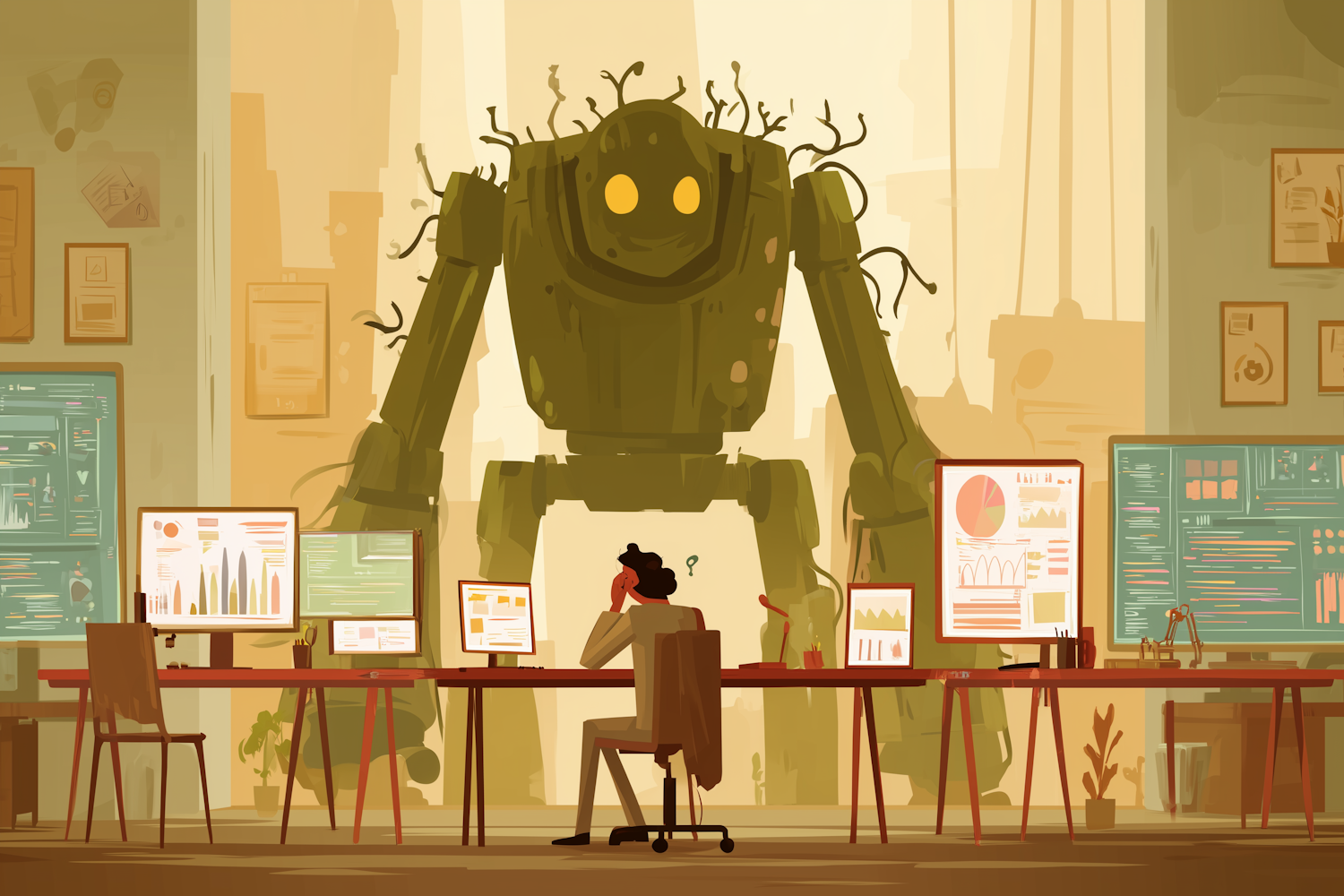
Turn AI anxiety into strategic advantage with this practical recipe
The Great AI Panic of 2025
Are you losing sleep over whether AI will nick your PM job? You’re not alone. A recent Reddit discussion perfectly captured the anxiety gripping our community – one PM boldly claimed AI makes our jobs “more secure,” only to be met with a chorus of sceptical voices predicting layoffs, increased workloads, and the dreaded “feature factory” fate.
The truth? We’re all standing at the crossroads, wondering which path leads to career survival and which leads to redundancy. Some of you are already watching AI tools churn out user stories faster than you can say “sprint planning,” whilst others are fielding questions from leadership about whether we really need five PMs when ChatGPT can write a PRD in minutes.
When Your Kitchen’s in Chaos
Here’s what’s really happening: the PM community feels like a busy kitchen during the dinner rush, but half the staff’s been replaced by food processors, and nobody’s quite sure who’s supposed to be head chef anymore. You’ve got junior PMs frantically writing JIRA tickets (the culinary equivalent of prep work), senior PMs trying to justify their strategic value, and executives eyeing the AI tools wondering if they can cut costs by automating the lot.
The Reddit thread revealed our deepest fears: that employers see AI as a cost-cutting tool rather than a capability enhancer. One commenter nailed it: “Only if their employers also think so. Doesn’t matter what PMs think.” Another warned about the expectation to “crank out 5X as many PRDs” without additional compensation. Sound familiar?
Meanwhile, those PMs stuck in feature factories – copying competitors, writing tickets, managing backlogs without strategy – are discovering they’re in precisely the roles AI excels at. It’s like being a baker who only follows recipes when artisan bread-making machines are taking over the high street.
The Recipe for AI-Proof Product Management
Right, enough doom and gloom. Here’s your practical survival recipe – and it’s simpler than you think:
1. Lead the Conversation, Don’t Wait for It
Stop letting leadership discover AI tools on their own and draw their own conclusions about your role. Be the PM who researches, pilots, and presents AI integration strategies. Position yourself as the expert who understands both the technology’s potential and its limitations. You wouldn’t let engineering choose the product roadmap – don’t let them choose your AI future either.
2. Double Down on Your Irreplaceable Skills
AI can write user stories, but it can’t navigate the politics when Sales promises a feature that Engineering says is impossible whilst Marketing needs it yesterday. Focus relentlessly on:
- Stakeholder choreography: managing competing priorities and egos
- Strategic intuition: seeing opportunities that data alone can’t reveal
- Context translation: turning business needs into technical requirements (and vice versa)
- Crisis management: when things go sideways (they always do)
3. Reframe Your Value Proposition
Stop selling yourself as the person who writes requirements. Start positioning yourself as the strategic conductor who orchestrates AI tools to deliver business outcomes. You’re not competing with AI – you’re the human who makes AI useful for your business context.
4. Build Your AI Fluency (But Don’t Become a Tools Expert)
You don’t need to become an AI engineer, but you absolutely need to understand what these tools can and can’t do. Spend time with AI-powered research tools, experiment with automated user story generation, and learn to spot when AI output needs human judgement. Be conversational, not evangelical.
5. Document Your Strategic Wins
Start tracking and sharing the strategic decisions that only human judgement could make. When you pivot a feature based on customer feedback that contradicted the data, when you negotiate a compromise between teams, when you spot a market opportunity – these are your case studies for irreplaceable value.
The Reality Check
Will some PM roles disappear? Absolutely. The ones focused purely on documentation, feature copycat work, and administrative tasks are vulnerable. But here’s the thing about operational sectors like retail and restaurants – they’re full of complex, human-centred problems that require intuition, empathy, and strategic thinking.
Your customers aren’t just data points – they’re real people with messy, contradictory needs. Your stakeholders aren’t rational actors – they’re humans with competing agendas and emotional investment in their ideas. AI can support this work brilliantly, but it can’t replace the human who understands the nuance.
Stop Worrying, Start Positioning
The PMs who thrive in the AI age won’t be the ones who fight the technology – they’ll be the ones who position themselves as essential partners to it. They’ll use AI to handle the routine stuff so they can focus on the strategic, creative, and relationship-heavy work that creates real business value.
Remember: every technological shift creates anxiety, but it also creates opportunity. The question isn’t whether AI will change product management – it’s whether you’ll be proactive enough to shape how it changes your role.
Your next step? Pick one AI tool relevant to your work, spend a week learning it properly, then present your findings to your team with specific recommendations for integration. Show don’t tell – and position yourself as the strategic thinker who makes AI work for your business.
Transform AI anxiety into your competitive edge – start today.
Leave a Reply