
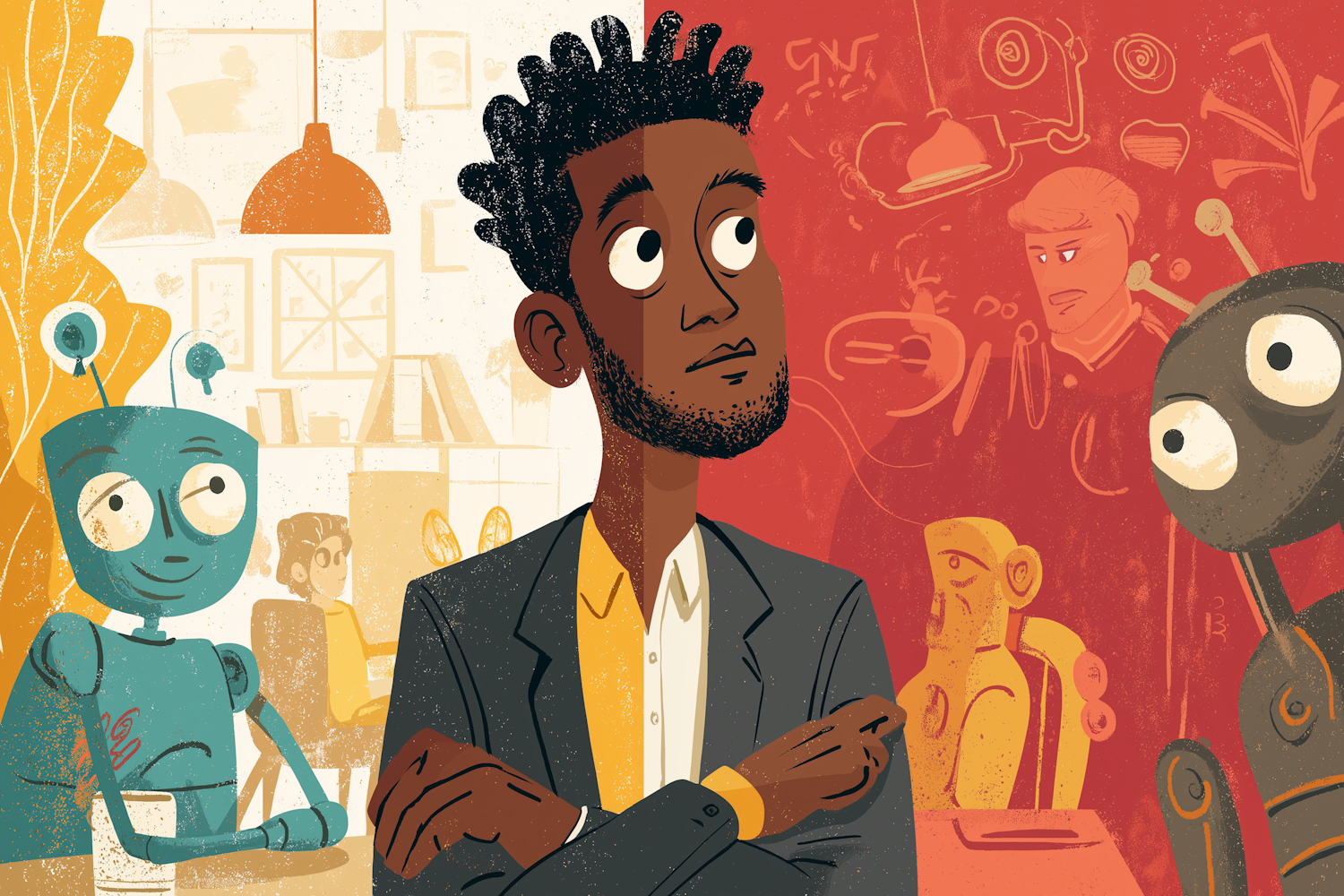
What CPOs really think about AI’s role in product teams
Are you lying awake at night wondering if your CEO sees AI as your job’s salvation or your replacement? You’re not alone.
Every Product Manager I’ve spoken to lately is grappling with the same burning question: when the C-suite talks about “AI transformation,” are they plotting to empower us or quietly calculating how many fewer PMs they’ll need next quarter?
It’s the elephant in every stand-up, the subtext in every strategy meeting. And frankly, the uncertainty is doing our heads in.
When Your Perfect Sourdough Starter Goes Rogue
Imagine you’ve spent months nurturing the perfect sourdough starter – carefully feeding it, monitoring its bubbles, understanding its rhythms. You’re finally ready to bake that show-stopping loaf you’ve been dreaming of.
Then your flatmate suggests replacing your precious starter with instant yeast packets from Tesco. “Same result, half the faff,” they say with a shrug.
That’s exactly how many PMs are feeling about AI right now. We’ve spent years building our craft – learning to read between the lines of stakeholder requests, translating business gibberish into user value, orchestrating the delicate dance between engineering, design, and commercial teams. Now there’s this nagging fear that our CEOs see all that nuanced expertise as… well, just expensive faff that a chatbot could handle for £20 a month.
The online PM community is buzzing with anxiety. One recent Reddit thread exploded with comments like “Only if their employers also think so. Doesn’t matter what PMs think” and “The expectation won’t be cranking out 5X as many PRDs instead of spending more time developing strategy.”
It’s enough to give anyone digestive biscuit cravings and a case of imposter syndrome.
The Real Recipe from the Top Shelf
Here’s what I discovered after chatting with CPOs and VPs of Product who are actually implementing AI in their teams right now: the reality is far more nuanced than the doom-scrolling suggests.
The successful leaders aren’t using AI as a replacement ingredient – they’re treating it like a brilliant sous chef that handles the prep work so their star bakers (that’s you) can focus on creating something extraordinary.
The Three-Tier Approach That’s Actually Working
Tier 1: Automating the Admin Avalanche
Smart CPOs are using AI to tackle what one leader called “the paperwork prison” that bogs down good PMs. Think automated meeting notes, first-draft PRDs, competitive analysis summaries, and basic user story formatting. It’s not replacing PM thinking – it’s clearing the kitchen counter so you can actually think.
Tier 2: Amplifying Strategic Senses
The cleverer leaders are using AI to enhance PM superpowers, not replace them. AI can quickly analyse user feedback patterns, suggest feature prioritisation based on data trends, or help prototype solutions faster. But the strategic decisions, the “why should we build this” conversations, the stakeholder negotiations? That’s still pure human territory.
Tier 3: Creating New Value Streams
The most forward-thinking CPOs see AI as opening entirely new opportunities. One retail VP told me, “AI doesn’t reduce my need for PMs—it increases it. We can now explore personalisation strategies and dynamic pricing models that would’ve taken us years to test manually. I need more strategic thinking, not less.”
The Skills That Make You Irreplaceable
Every single leader I spoke to mentioned the same thing: soft skills are becoming the new hard currency.
While AI can draft a requirements document, it can’t:
- Navigate the politics when sales promises a feature that engineering says is impossible
- Read the room during a tense stakeholder meeting
- Build trust with a sceptical engineering team
- Translate a customer’s frustrated complaint into a breakthrough insight
- Rally a team around a vision when the roadmap gets turned upside down
One CPO put it perfectly: “I can teach AI to write tickets. I can’t teach it to inspire humans.”
The Two Types of PMs (And Which One Thrives)
Here’s the uncomfortable truth that emerged: not all PM roles are created equal in the AI age.
The “Feature Factory” PM (the one who mainly writes tickets, copies competitor features, and manages Jira boards) is genuinely at risk. If that’s primarily what you’re doing, AI can probably do it faster and cheaper.
The “Strategic Orchestrator” PM (the one who connects dots between user needs and business value, facilitates difficult decisions, and shapes product vision) becomes more valuable, not less. These PMs use AI as a power tool, not a replacement.
The question isn’t whether AI will change PM work – it’s which type of PM you choose to become.
Your Recipe for AI-Proofing Your Role
- Audit your current recipe: Honestly assess how much of your time goes to admin versus strategy. If it’s more than 50% admin, that’s your growth opportunity.
- Double down on human superpowers: Invest in stakeholder management, conflict resolution, and strategic thinking. These aren’t just “nice to haves” anymore – they’re your competitive advantage.
- Become an AI power user: Don’t fear the tools; master them. The PMs who thrive will be those who can wield AI effectively while focusing their human energy on high-value work.
- Focus on outcomes, not outputs: Shift conversations from “how many features did we ship?” to “what customer problems did we solve?” AI can help with the former; only you can drive the latter.
- Build your internal brand: Make sure your leadership knows you’re the strategic thinker, not just the person who writes the documentation.
The most successful CPOs I spoke to aren’t looking to cut PM headcount – they’re looking to elevate what their PMs can accomplish. But that elevation requires us to rise to the occasion.
Your sourdough starter isn’t going anywhere. It’s just getting some seriously good kitchen equipment to help it create something even more extraordinary.
Leave a Reply